
Serum-free vs FBS guide
Serum-free media or FBS
A clear-eyed comparison for choosing a cell culture supplement: cost, reproducibility, protocol compatibility, regulatory fit, and the transition effort most switching decisions underestimate.
Free 50 mL FBS sample to qualify a lot
Why this guide exists
Most switching decisions skip the transition math
The serum-free versus FBS question is usually framed as a quality or ethics decision. In practice it is a fit decision: serum-free media wins decisively for clinical manufacturing and defined-background work, FBS wins for routine research, and the transition between them carries a real, often underestimated cost. This guide lays out the head-to-head, the application-by-application recommendation, and the true first-year cost of switching.
Decision frame
Three filters before you switch
01
Filter one
Regulatory requirement
02
Filter two
Application type
03
Filter three
Transition budget
Head to head
FBS vs serum-free media
| Factor | FBS | Serum-free media |
|---|---|---|
| Cost per litre of finished media | Low; one 500 mL bottle supplements about 5 L at 10 percent | High; sold ready-to-use, roughly $200 to $800 plus per litre |
| Lot-to-lot variability | Present, managed with lot testing and lot reservation | Minimal; chemically defined |
| Protocol compatibility | Universal; works with published protocols | Cell-line-specific; optimization required |
| Growth factor content | Broad-spectrum, thousands of serum proteins | Defined, limited to added factors |
| Primary cell support | Excellent | Poor to moderate |
| Reproducibility | Good with lot reservation | Excellent |
| Regulatory and GMP fit | Requires documentation; animal-origin considerations | Preferred for clinical manufacturing |
| Transition effort | None; the established standard | 2 to 6 months per cell line |
| Ethical profile | Animal-derived; ISIA-traceable supply chain | Animal-free formulations available |
By application
Which supplement fits your work
| Application | Recommendation | Why |
|---|---|---|
| Routine cell line maintenance | FBS | Proven, cost-effective, universally compatible |
| Primary cell isolation | FBS | Broad growth factors are essential for initial attachment |
| Stem cell culture | Either | Defined serum replacements work for some protocols; FBS is still used for many |
| CAR-T and cell therapy manufacturing | Serum-free | GMP requirement and regulatory preference for defined media |
| Antibody production | Serum-free | CHO serum-free media is well-optimized; serum proteins contaminate the product |
| Immunology assays | FBS | Heat-inactivated FBS is the standard; switching disrupts established baselines |
| Proteomics and secretome | Serum-free | Serum proteins create an unacceptable background |
| Drug screening | FBS | Published IC50 values assume FBS; lot reservation holds consistency |
| Virus production | Either | Depends on whether the downstream use is research or clinical |
Switching note
The transition principle
Switch to serum-free for a regulatory requirement, not for a marketing whitepaper. When GMP demands a defined formulation, the transition cost is justified. When it does not, run the true first-year math before you move a line.Innovative Bioscience cell-culture team.
Total cost of ownership
The true first-year cost of switching
| Cost category | FBS (current) | Serum-free (transition) |
|---|---|---|
| Media cost, per year, three cell lines | $2,550 to $3,570 | $3,000 to $6,000 |
| Optimization time, PI and postdoc | None | $5,000 to $15,000 |
| Failed experiments during transition | None | $2,000 to $8,000 |
| Protocol revalidation | None | $1,000 to $5,000 |
| Approximate first-year total | $2,550 to $3,570 | $11,000 to $34,000 |
Figures are illustrative ranges for a typical three-line academic lab, not a quote. The FBS media-cost line reflects Research and Advance grades supplemented at 10 percent. A regulatory-driven switch justifies the transition investment; a discretionary one rarely does once the full first-year cost is counted.
Frequently asked
Six questions before you choose a supplement
Is serum-free media better than FBS?
Neither is universally better. Serum-free media is chemically defined and preferred for GMP and clinical manufacturing; FBS is broad-spectrum, universally protocol-compatible, and far less expensive per litre of finished media. The right choice depends on your application, your regulatory requirements, and your transition budget.
Why is FBS so much cheaper than serum-free media?
FBS supplemented at 10 percent costs a fraction of chemically defined serum-free media per litre of finished media. A single 500 mL FBS bottle supplements roughly 5 litres of media. Serum-free media is sold ready-to-use and carries the full cost of its defined formulation.
How long does it take to transition a cell line to serum-free?
Plan on 2 to 6 months per cell line. Serum-free media is cell-line-specific and usually needs optimization, protocol revalidation, and a period of inconsistent or failed experiments before the line is stable.
When is serum-free media the clear choice?
For CAR-T and clinical cell manufacturing, antibody production in CHO cells, proteomics and secretome work where serum proteins create background, and any GMP workflow where a defined, animal-free formulation is required or strongly preferred.
When does FBS remain the better choice?
Routine cell line maintenance, primary cell isolation, immunology assays, drug screening against published IC50 values, and teaching. FBS is proven, forgiving, and universally compatible with published protocols.
Can I reduce lot-to-lot variability with FBS?
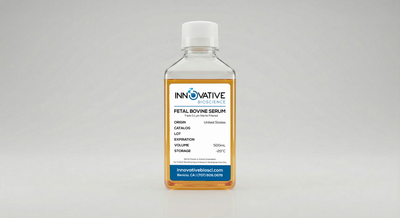
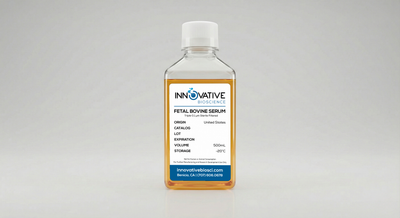
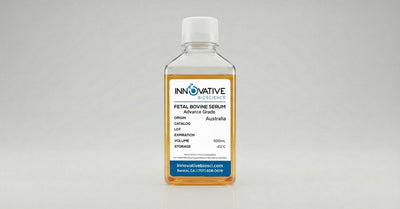
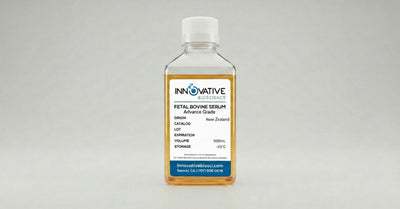
Yes. Lot reservation lets you hold a single qualified lot for a multi-year project, and every Innovative Bioscience lot ships with a lot-specific Certificate of Analysis. Request a free 50 mL sample to qualify a lot in your own culture system before committing.
Free 50 mL evaluation samples
Qualify a lot on your own cell lines
Every lot ships with a lot-specific Certificate of Analysis, same-day cold-chain on dry ice before 2 PM PT.
Quality and ordering
Every FBS lot ships with a lot-specific COA
USDA-traceable, BSE-negligible origins, triple 0.1 micron sterile filtered, 9CFR virus panel tested. Same-day cold-chain shipping before 2 PM PT. Volume and institutional pricing, purchase orders, and Net 30 and Net 60 terms available for labs and procurement teams.
- Free 50 mL sampleany FBS grade, dry-ice shipped
- 9CFR testedtriple 0.1 micron sterile filtered
- Lot reservationhold one lot for multi-year work


