
FBS comparison guide
Heat-inactivated vs standard FBS
Heat inactivation knocks out complement, but it is not free. Use standard FBS for routine culture; heat-inactivate only when complement interferes with your assay.
Standard protocol: 56°C water bath, 30 minutes
The honest framing
Heat inactivation is rarely required
Heat inactivation (56°C for 30 minutes) destroys complement proteins in FBS that interfere with specific immunological assays. The truth most suppliers will not tell you: the majority of cell culture applications do not require heat-inactivated serum. Understanding when HI-FBS is truly necessary saves your lab both time and money — especially since we offer heat inactivation as a $10 add-on rather than charging $200+ per bottle.
Heat inactivation protocol
Three checkpoints, one pass
01
Step one
Thaw and stabilize
02
Step two
56°C for 30 minutes
03
Step three
Cool and aliquot

When you need it
Heat inactivation is recommended for these workflows
Complement-sensitive assays: complement fixation, CDC assays, ADCC.
Immunological studies: T-cell activation, lymphocyte proliferation, mixed lymphocyte reactions.
Transfection protocols: complement can lyse transfected cells.
Insect cell culture: Sf9 and Hi5 lines.
If your work involves measuring immune responses, or you are seeing unexplained cell death in complement-dependent systems, HI-FBS is the right choice.

When standard is better
For most cell culture, standard FBS performs equally or better
For the vast majority of cell culture , including CHO, HEK293, HeLa, primary fibroblasts, and most adherent cell lines , standard FBS performs equally well or better than heat-inactivated.
Heat inactivation denatures some growth factors and proteins, which can slightly reduce growth rates in sensitive cultures.
Standard FBS is preferred for: routine cell maintenance, primary cell isolation, stem cell expansion (most protocols), viral propagation, and any workflow where complement is not actively measured.
Method tradeoff
The honest tradeoff
Heat inactivation removes complement, but degrades growth factors by 10 to 20% and increases precipitate. Use it only when complement interferes with your assay.Major suppliers including Sigma-Aldrich, Thermo Fisher, and Capricorn Scientific note this trade-off in their technical bulletins.
When to use which
Standard vs heat-inactivated, by application
| Application | Standard FBS | Heat-inactivated FBS | Why |
|---|---|---|---|
| Routine cell culture (HeLa, CHO, HEK293) | Recommended | Optional | Complement is rarely active in established cell lines. |
| Primary cell isolation | Optional | Recommended | Active complement can lyse delicate primary cells during isolation. |
| Immunology and complement-fixation assays | Avoid | Required | Active complement directly interferes with the assay readout. |
| Stem cell culture (mouse ES, iPSC) | Optional | Often preferred | Some protocols specify HI to reduce undefined background activity. |
| Hybridoma culture | Avoid | Recommended | Complement can lyse hybridoma cells; HI eliminates this. |
| Antibody production | Optional | Recommended | HI reduces non-specific complement-mediated effects in supernatants. |
| Viral propagation | Recommended | Avoid | Heat may reduce viral titer for some sensitive viruses; not for inactivation. |
Frequently asked
Six questions cell-culture leads ask us
When do I need heat-inactivated FBS?
Heat inactivation is needed when complement proteins in serum interfere with your assay: classical immunology assays, primary cell isolation, complement-fixation tests, certain stem cell protocols, and specific viral inactivation use cases. Most routine cell culture (CHO, HeLa, HEK293, immortalized lines) does not require it.
What is the standard heat-inactivation protocol?
56°C water bath for 30 minutes, with gentle swirling every 5 to 10 minutes to ensure even heat distribution. Pre-thaw the FBS first per the standard thawing protocol, then transfer to the 56°C bath. Do not exceed 56°C or 30 minutes; growth-factor degradation accelerates beyond that.
Does heat inactivation affect cell-culture performance?
Yes, mildly. Heat inactivation reduces complement activity to near zero, but also degrades growth factors by approximately 10 to 20% and increases insoluble precipitate. For complement-sensitive assays the trade-off is justified. For routine culture, standard FBS performs better.
Can I order heat-inactivated FBS pre-prepared?
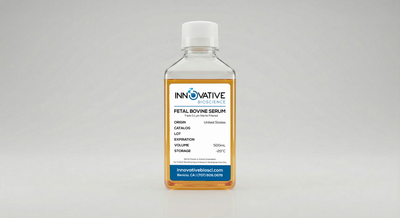
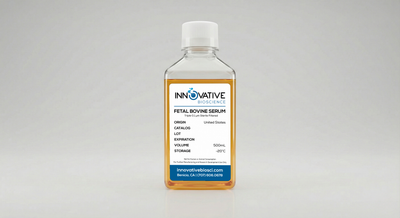
Yes. Innovative Bioscience offers heat inactivation as a paid service on any FBS product (US Origin, USDA-Approved, or charcoal-stripped). Add-on price: $10 per 500 mL bottle. We perform the protocol in our facility under documented conditions.
Should I heat-inactivate FBS in-house or order it pre-inactivated?
Either works. Pre-inactivated saves bench time and gives you documented heat-treatment records on the COA. In-house lets you control timing and confirm the inactivation just before use. The protocol is well-defined; both routes give equivalent results.
Does heat inactivation kill viruses?
No, not reliably. 56°C for 30 minutes inactivates most enveloped viruses but does not inactivate many non-enveloped viruses or prions. Viral safety in FBS comes from sourcing (USDA-approved BSE-free regions) and gamma irradiation if requested, not from heat inactivation.
Free 50 mL evaluation samples available
Standard or heat-inactivated, same FBS quality
Add heat inactivation as a $10 service to any FBS product. Same lot, same COA, processed at 56°C for 30 minutes.
Ordering and add-on
Standard or heat-inactivated, same FBS quality
Add heat inactivation as a $10 service on any FBS product (US Origin, USDA-Approved, or charcoal-stripped). Documented protocol on the COA. Same-day cold-chain shipping before 2 PM PT.
- 56°C / 30 minStandard inactivation protocol
- +$10 per bottleAdd-on to any FBS catalog item
- COA per lotHeat-treatment documented


